Published
War Requiem
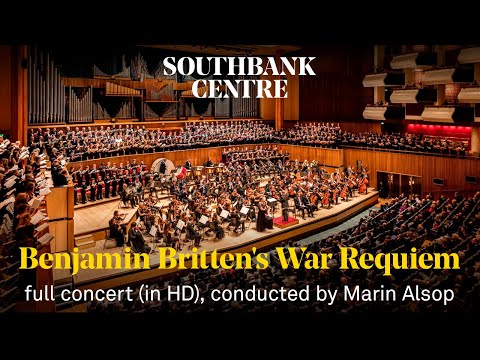
The War Requiem, Op. 66, is a choral and orchestral composition by Benjamin Britten, composed mostly in 1961 and completed in January 1962. The War Requiem was performed for the consecration of the new Coventry Cathedral, in the English county of Warwickshire, which was built after the original fourteenth-century structure was destroyed in a World War II bombing raid. The traditional Latin texts are interspersed, in telling juxtaposition, with extra-liturgical poems by Wilfred Owen, written during World War I.
The War Requiem, first performed on 30 May 1962, was commissioned to mark the consecration of the new Coventry Cathedral, which was built after the original 14th-century structure was destroyed in a World War II bombing raid.
Britten, a pacifist and conscientious objector, was inspired by the commission, which gave him complete freedom in deciding what to compose. He chose to set the traditional Latin Mass for the Dead interwoven with nine poems about war by the English poet Wilfred Owen. Owen, who was born in 1893, was serving as the commander of a rifle company when he was killed in action on 4 November 1918 during the crossing of the Sambre–Oise Canal in France, just one week before the Armistice. Although he was virtually unknown at the time of his death, he has subsequently come to be revered as one of the great war poets.
Britten dedicated the work to Roger Burney, Piers Dunkerley, David Gill, and Michael Halliday. Burney and Halliday, who died in the war, were friends of Peter Pears and Britten, respectively. According to the Britten-Pears Foundation’s War Requiem website, Dunkerley, one of Britten’s closest friends, took part in the 1944 Normandy landings. Unlike the other dedicatees, he survived the war but took his own life in June 1959, two months before his wedding. None of the other dedicatees have known graves, but are commemorated on memorials to the missing.
Although the Coventry Cathedral Festival Committee had hoped Britten would be the sole conductor for the work’s premiere, shoulder pain forced his withdrawal from the main conducting role. He did, however, conduct the chamber orchestra, and this spawned a tradition of separate conductors that the work does not require and Britten never envisaged. The premiere took place on 30 May 1962, in the rebuilt cathedral with the City of Birmingham Symphony Orchestra, conducted by Meredith Davies (accompanying soprano and chorus), and the Melos Ensemble, conducted by the composer (accompanying tenor and baritone). At Britten’s request, there was no applause following the performance. It was a triumph, and critics and audiences at this and subsequent performances in London and abroad hailed it as a contemporary masterpiece. Writing to his sister after the premiere, Britten said of his music, “I hope it’ll make people think a bit.” On the title page of the score he quoted Wilfred Owen:
My subject is War, and the pity of War.
The Poetry is in the pity…
All a poet can do today is warn.