Published
Unrestrained Sound
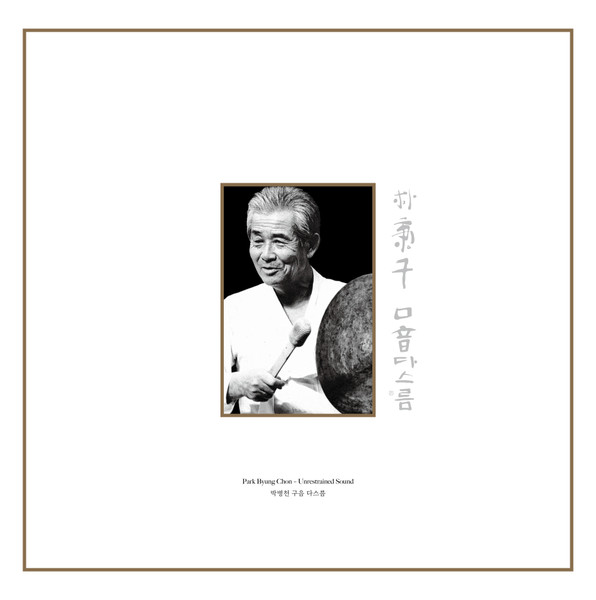
The scene seems strange to me. When the cherry blossom season sets in, they come out of nowhere, drink and dance gracefully to the rhythm of the drums. To the rhythm of the drums? That is strange. Since nobody dances in the same pattern. Everyone dances freely. They are dancing to the same rhythm, however, in a sense that each dance seems to be a part of an enormous thing like an arc or ring. The dance and the song of Korea surprises us with their being absolutely free, or rather it is more appropriate to say that they seem “free” to the eyes of those living in the “unfree” world.
Listening to the overwhelmingly beautiful and free wheeling voice, we become stupefied for a while. The magical element in Park Byung-Chon’s voice is certainly a witchcraft to the “unfree” ears. The tone is not only masculine but also sweet ; men as well as women would be fascinated with it.
Born in the family of Shaman of Chindo island located in the southwest of Korea, Park is also the master of Jang-Gu and Jing. He is the intangible cultural property with the skill of shamans’ ceremony “Ssikimkut’ of Chindo Island, one of the leading dance accompanists and the head of the famous ‘Korea House’ in Seoul. In this CD, Park sings, beats and dances freely, he does so without and restriction. It is literally without and restriction. It goes without saying that his performance is based on the traditional rhythm and music in Namdo, southern district of Korea. Any listener would be surprised, however, to find the music played according to such tradition sounds so modern and pop.
Another surprising aspect of Korean music one encounters is that tradition is now merely kept and handed down but once entrusted to the hands of a performer changed and relived according to the character of the performer. The music in the CD, however, should be named “Park Byung- Chon Music” though it is based on the traditional music. It is absolutely unique.
Dancing – in fact he did not play dancing. But you never fail to notice that subliminal beat roaring through the earth is “grooved” from the tunes ensemble by three members in which Lee Tae-Baek plays Ajaeng and Park Hwan-Young, a son of Park, plays Daegeum or Jang-Gu to last tune in which Park sings all alone with his own accompanying of Jing.
One another surprise in Korean music : that is “groove”. It is not too much to say that every single sound is directly related to dance in Korea. You don’t need regular rim shot any more. Instead more irregular rhythm which is in accordance with human nature would appear. Park’s voice dances like a butterfly and stings like a bee through the flowers of these complex rhythms.
The listeners who got a sting would be poisoned. Behind the facade of his sweet voice is the trap of narcotic. The antidote against this narcotic is ‘Tasurim’ which means “to be free to be oneself”
There is one short story titles “Destroy’ Ayler said.” Written by Nakagami kenji, a Japanese writer. Even though I feel something ironical in this title, many Jazz players who plunged oneself into Free Jazz movement in Europe and in USA in 1960s destroyed everything in the name of “free” and were eventually forced to destroyed everything in the name of “free” and were eventually forced to destroy themselves. In the whirlpool of the movement the saxophone player Alber Ayler played, and sang freely and innocently as a new-born baby, and died. It would be never judged whether Ayler’s music was “Free Jazz” or not. It is so free that we cannot give it any name. I cannot help feeling such free aspect of Ayler’s music overlapping upon Korean music, especially Park Byung-Chons’ Tasrurim.
Written by Miyakoshi Kiroki (a music fancier) Feb. 1994 in Japan. Translated by Yamamura Tetsuo
The word salpuri literally means “to drive away evil spirits.” In this context it signifies purification: 살 (sal) means calamity, while 풀이 (puri) derives from the verb 풀다, meaning to release or let loose. It is a characteristic shamanic dance with exorcistic functions. Historically, salpuri dances were generally performed at the end of the gut, or shamanic rite, especially in southern regions such as Jeolla.