Published
Icaros de Vida, Muerte y Resurreción
Recorded in 2020, this album features sounds from a night and a day spent with the Shawis of Iquitos.
The vehicle that took them to the Shawi chacra was large enough to carry the six members of the film crew as well as the shaman, “Uncle” Rafael. Pablo repeatedly tried to speak with him, but communication was extremely sparse: the man offered little more than a few smiles and affirmations, as though he spoke a different language. Conversations with members of the communities generally came down to this—smiles and laconic, hard replies, without jokes, descriptions or gestures. Things as they are.
The journey by car was uncomfortable. An hour and a half after setting out, the vehicle left them in the middle of nowhere, in the jungle, ready for the second challenge: walking to the isolated community. A muddy path covered with leaves stretched endlessly up and down through the humid, slippery terrain. Pablo loaded himself with the equipment and in less than ten minutes had sweated through his T-shirt and shorts. Rotten greenery extended in every direction. As they walked, Rafael distinguished between primary and secondary forest. Pablo, who was right behind him and almost stepping on his heels, understood very little. The soles of his shoes had come loose several days earlier. Partly separated from the uppers, they resembled the mouth of a head stuttering with every step. Mud entered the mouth of this imagined animal.
They passed a sawmill.
“The Amazon is one enormous sawmill,” Pablo thought. Piles of long, soft timber appeared beside the path. There was a kind of oven or pyramid made of logs, used for burning wood and producing charcoal. The structures looked interesting. They crossed bridges built entirely from wet wood, which bounced up and down beneath their feet.
Exhausted, they finally reached the entrance to the chacra. A dozen children and several adult men emerged from a large hut, almost all of them wearing football shirts. Their average age was around thirty. They were short but muscular. For some reason, their faces suggested age and fatigue. Perhaps living in this place of agony and death, life and rebirth ultimately left a mark on their bodies. Even so, they were energetic, spoke in their own language, and laughed. Comments and jokes passed among them. Mud covered the entire floor of the hut. The beds stood about a metre and a half above the ground, probably to escape the water during periods of prolonged rain and perhaps also to prevent animals from unexpectedly entering their dreams. The gigantic backside of a female “model” from a pornographic magazine spread modestly across the page of a calendar for the current year, attached to one of the cane walls. In the hut’s main space, the women and mothers remained as though hidden, invisible. Almost all of them looked down.
About fifteen minutes later, Pablo spoke briefly with the children, recorded their names and took out the microphone to capture voices speaking Cocama, the language of the Shawis. Large drops of sweat ran from his forehead. There was no sun. Rafael told them that the purge ceremony would take place farther away from the house. Only faint traces of daylight remained on the horizon as they moved towards the designated place.
They began tying the hammocks in which they were supposed to sleep beneath a roof without walls. Pablo was completely out of his depth, doing something he had never done before and struggling to secure one end. A single light bulb, a little more than two metres above them, illuminated the damp place. Beyond it, an overwhelming silence.
This sun illuminated the surrounding universe in which the hours would unfold: the wall-less shelter where the hammocks were hung; the central hut; and a small wooden house beside it, accessible over a log and then a step more than a metre and a half above the ground. The only opening in this room was the entrance. There were no windows or comforts inside, not even a bed. All the Shawis slept lying on the hard wooden floor.
Seeing that conditions inside this cabin were better than outside in the hammocks, Rafael suddenly decided to bring the “gringos” indoors and instructed them to leave their belongings there. They piled the hammocks on the floor and placed water and toilet paper nearby. Their sweat-soaked T-shirts were hung from ropes crossing the room from one side to the other.
Rafael gave a brief introduction to the purge they were about to experience.
Then he said goodbye:
“Now I’m going to bathe in the river, and then I’ll come back so we can begin the ceremony.”
Under his breath, Pablo wished the participants luck and quickly prepared everything needed for the recording. He was happy and anxious. Rafael returned wearing a rather warm polo shirt. It was obvious that he would sweat during the process, but he did not seem concerned; in fact, he looked as though he were dressed to go out to a restaurant. From the centre of the sky came the deepest, largest and most beautiful clap of thunder. Pablo again felt calm and joyful. He could not move much, however, because he was holding the microphone, which was already recording.
Rafael had spoken very concisely about the effects of the drink. He emphasised the cerebral connections that lit up when it began to act and identified three stages they would pass through. The first was mareo, the immediate effect beginning about ten minutes after drinking the liquid. The idea was to wait for the plant and offer it a kind of welcome.
“You must not be afraid or move too much during the nausea, because you have to try not to vomit all the liquid you have swallowed.”
The second stage was hallucinatory: different beings, figures, symbols and colours would begin to appear in the mind. Rafael tried to persuade them that these visions formed part of the reality of the plant’s world. They needed the courage to keep searching rather than dissipate. Along the way, they should define—or establish as an objective—what they wished to ask the plant: what they truly wanted to ask and what it might answer.
The final state was “the vision”: the clear, real image of something sought. The answer.
At the main ceremony, Rafael showed them the liquid they would drink: a dark, viscous fluid that undoubtedly appeared very “pure.” The ideal combination was before them—the correct dose of ayahuasca with chacruna. One part carried the plant’s own life and knowledge; the other was responsible for the hallucination.
From where he stood, Pablo saw the liquid as a strong glue, something used to polish furniture. Rafael had all the participants smoke a mapochito, a kind of medicinal tobacco, and seated them around him: visitors and members of the community alike. Beside him was his “little nephew,” who would help when they sang the ícaros. Everyone drank the ayahuasca from a dirty yellow plastic bottle cap. Pablo held the microphone nervously.
“All right, now we are going to turn off the lights and let the spirit come. Be careful with the dizziness. The effect will last around four hours.”
Outside, the colour of the night turned fuchsia. Tiny drops struck the jungle’s dense foliage. Pablo imagined a river passing through everyone present, like a constant current, like a tube or dam of astronomical dimensions.
He decided to climb down from the house with all the recording equipment hanging from him and see what was happening. Flashes of lightning illuminated the faces and bodies of the Shawi participants, arranged however they could around the house. The hammock holding the “little nephew,” Nolberto, appeared in the light, cut out against the perfect background of trees. Far away, one tree rose above the rest, its trunk slender and much taller. Pablo pointed the microphone towards that immensity and then to either side. He counted everyone who was under the effect of the drink. There were twenty.
After fifteen minutes of apparent silence, retching began inside the main “house.” Pablo hurried to illuminate the space with his phone, especially the entrance, so that nobody would trip over anyone else or fall and kill themselves stepping on the log that served as a stair. It was Santiago, the first to pass from dizziness towards infinity. He climbed down quickly and vomited heavily. He had respected the fast less than anyone else and now, it seemed, was paying dearly for it.
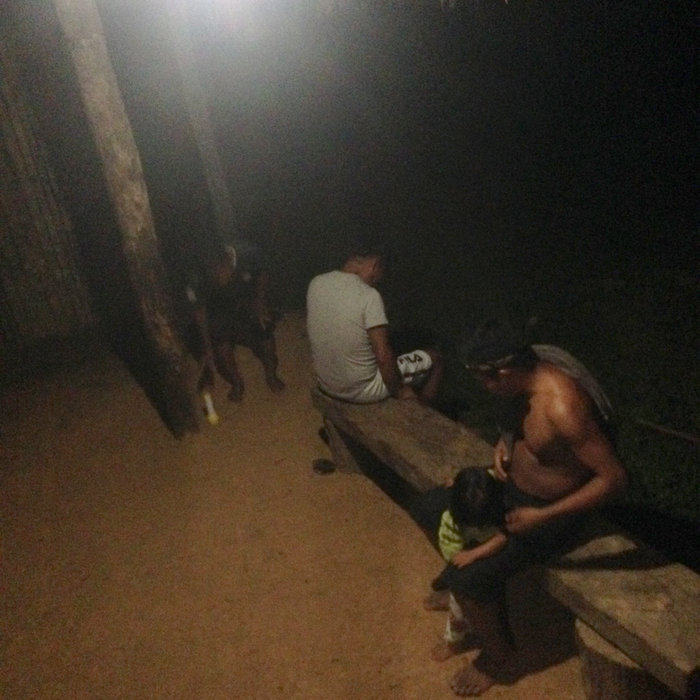
Pablo felt that Santiago was somehow cleansing himself. Purification came with every heave. Santiago displaced the outsiders sitting on one of the benches outside, sat down and lowered his head. At that moment the rain intensified. The “little nephew” began singing an ícaro, a ceremonial song mixing Shawi and Spanish:
“Little doctor, little doctor, bring me the medicine of the natural sciences.”
As he sang, he shook a palm leaf to maintain the rhythm, giving himself support amid his growing hallucination while directing part of that energy into the others’ channel, making their visions stronger and more concentrated.
Half an hour later, Rafael lay on a kind of wooden platform inside the main house beneath his own white mosquito net. If one listened carefully, sneezes and spits could be heard from within, thrown who knows where inside the pyramidal formation of “crystal.” Suddenly he emerged after several minutes of whistling ícaros amid the rain that covered everything. The palm leaf Rafael shook was larger and more powerful than his “little nephew’s,” although his intonation was emotionally and melodically poorer. After singing a couple of times and causing Santiago to continue vomiting outside the house, he fell silent again and withdrew into his pyramid.
Wearing headphones and “super-listening,” Pablo began to imagine—or discern—footsteps approaching and receding from every direction. He immediately thought of spirits arriving to accompany those who had consumed the drink, and heard their steps moving through the main room, which he later christened “the church.” Santiago continued vomiting. Pablo approached the “little nephew” to ask whether he should help him or wait until he was called.
“He will know when to ask for your help. He will call you by name.”
A few minutes later Santiago called out, asking Pablo to bring toilet paper from inside the house. Not even a fly moved indoors, except for the tiny red points of the mosquito coils used to drive away the zancudos, a kind of enormous mosquito. Pablo left the room trying to step softly and make as little noise as possible on the hut’s floor.
“I don’t know where to shit,” Santiago said against the backdrop of that fine, constant, continuous and changing rain.
“Take off all your clothes and shit naked somewhere over there,” Pablo replied, entirely convinced that he would do the same in Santiago’s situation.
Still dressed, Santiago walked a few steps onto the green grass and, in the white light of the thunder, lowered his trousers and defecated. In his state of heightened hearing, Pablo looked at him and perceived Santiago as though he were hanging from a rope. This vision, mixing imagination with perhaps some of the visions his companions were experiencing, lasted only briefly—for as long as Santiago remained there shitting in the open. He returned a few minutes later, soaked and asking for a towel because he was cold. His body seemed to give off an astonishing heat, with all the fury of a stove. Pablo advised him to take off his clothes, but Santiago insisted that he bring him a quick-drying towel. Pablo went back inside, brought the towel, and watched Santiago wrap himself in it and lean against a ladder leading to the second floor of the church, where a family of two appeared to be sleeping. The father of that family was in the same room as Pablo.
Suddenly, in the splendour of an intensely active night, he saw how the roles within the ceremony were distributed. It was as though they were inside a gigantic ship that rocked and ran aground with every wave.
Inside the large house was the shaman: the leader, the head of the process. Around him were the gringos, whom Pablo called “the dead.” They made no sound apart from a few moans caused by the severe dizziness they were suffering.
Outside, hanging in the hammock, faithful to a solid and unchanging style, was the “assistant,” the “little nephew”: the pole whose firmness held up the world. On the bench opposite him were “the drunks,” the local people and Shawis, completely dizzy and hallucinating, gripping the wooden structure as though aboard a tiny wooden Titanic sailing magnificently through the jungle. Nearby was Santiago, struggling and reconciling himself with the plant, playing the role of “the martyr,” or the person in films who receives all the bad news. Standing in front, moving back and forth, sharing in the deepest of his inner silences, was Pablo: “the ghost.”
Farther away from the main space were “the families,” sheltered inside their provisional little houses made of folding boards and raised above the ground, within the same white mosquito nets that acted as genuine screens for shadow plays whenever someone inside switched on a torch. Until then, Pablo had not seen any of the people who were nearby making almost no sound, although from time to time a woman laughed in the middle of the night. Perhaps she was thinking about the destroyed gringos, abandoned within their explorations. At one point, in this family area, one of the men who was sleeping—or not quite sleeping—let out a loud fart. Almost all the women in the “family” group answered with laughter. A child whimpered and complained within the dark mass. What a spectacle.
An hour later Rafael got up and sang again. The rain stopped during the song, leaving the night entirely black, without light or sound. His voice passed through everything. Activity diminished; nobody moved around the surrounding area any longer. They had reached the beginning of the darkness, the oil-black stain of that incomparable night. Pablo began hearing groans, although he could not tell whether they were real, distant sounds or products of his imagination.
A few minutes later, the little nephew launched into another powerful and singular ícaro.
Another half-hour passed. Rafael stood up, switched on the lights and spoke with all the gringos about how they had experienced the ceremony….