Published
async
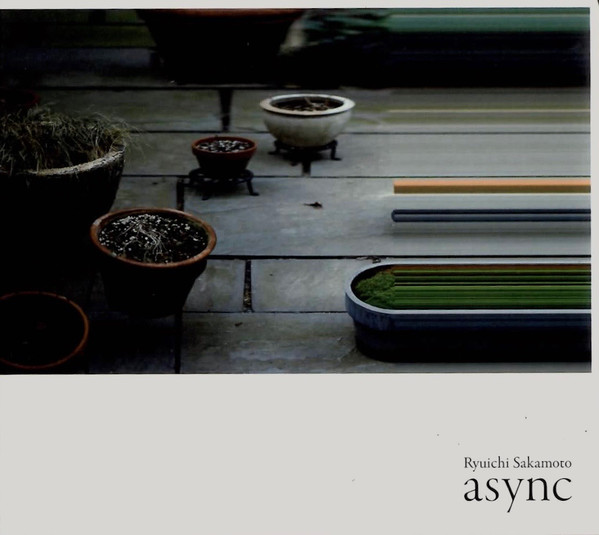
async is the nineteenth solo studio album of Japanese musician Ryuichi Sakamoto and his first one in eight years since Out of Noise (2009). It is also his first full-length solo record since recovering from throat cancer in 2015. Consisting of a combination of unusual interpretations of familiar musical instruments, textures both acoustic and electronically made, samples of recordings of people such as David Sylvian and Paul Bowles doing readings, and everyday sounds borrowed from field recordings of city streets, async has underlying themes of the worries of the end of life and the interaction of differing viewpoints in humanity.
He started sketching ideas for a solo album in 2014, but they were scrapped after he was diagnosed with throat cancer in 2014, after which he had to pause his career entirely. Despite recovering from the disease in August 2015, Sakamoto thought async would be his last album: “That’s why I tried to forget all the rules and forms, anything. I just wanted to put down just what I wanted to hear, just a sound or music, it doesn’t matter. This could be the last time.” The only track made before Sakamoto’s cancer diagnosis that appears on async is “andata.”
When making async, “I just wanted to hear sounds of things, everyday things, even the sounds of instruments, musical instruments as things,” Sakamoto said. Sakamoto cited the works of sound art sculptor Harry Bertoia as a major influence when making the album. The instrumentation includes both regular orchestral instruments and unusual acoustic and programmed textures, more specifically bizarre interpretations of otherwise familiar instruments and the “musical aspect[s]” of everyday noise. async employs a variety of sound-producing techniques, such as field recordings, making mist textures out of chorales, and wailing sounds from glass. Some of the tracks include out-of-tune pianos; he recorded two Steinway pianos he had in his home studio, and a piano that was drowned in tsunami water was used on the track “Zure.” He thought it was “nature” that was responsible for the notes the broken pianos played: “the piano is a very systematically, industrially-designed thing, but they were a part of nature, taken from nature. Mankind artificially tuned and set the well-tempered scale, but the thing is if you leave the piano for a long time without a tuning, it will be out of tune.”
According to Sakamoto, his musical interests were moving towards “sound and music” rather than just “music” while producing the album, and thus he incorporated field recordings to capture “lots of strange sounds.” Sakamoto did the field recordings by walking through streets in New York City, Tokyo, Kyoto, and Paris with a cell phone microphone in his hand, activity that made up for four months of the album’s production. The sounds he captured were those all people unavoidably encounter in everyday life, such as street noise, animal sounds, leaves, water, and rain.
He explained, “As human beings, we […] take the liberty to decide which sound is good or bad. […] I’m suggesting we open our ears and listen to each sound without prejudice.” Sakamoto did this to symbolize as well as commentate on how the differing viewpoints of humanity worked: “In this world of myriad viewpoints and unlimited information, every single person is choosing only the information that he or she is interested in, and people with similar interests gather and form a group. Then, groups with similar interests exchange views with one another, accelerating the movement to narrow the conversation down to ever-more specific views bound by a particular concern. And so, groups with different interests barely communicate with each other, or even if they do, they tend to dismiss the views of the other.” The message of async is that, like dissonant sounds coming together to create music, humans of all different viewpoints should come together and respect each other.
Some critics noted Sakamoto’s worries about death seeping into the album, which were influenced not only by his experience with cancer but also the many earthquakes and tsunamis that occurred in Japan in 2011. He said in an interview, “We were warned about how our civilization is fragile and how the force of nature is great.”
“We get to think of life as an inexhaustible well. Yet everything happens only a certain number of times, and a very small number, really.” He also says on the song, “Because we don’t know when we will die, we get to think of life as an inexhaustible well. How many more times will you watch the full moon rise? Perhaps 20. And yet it all seems limitless.”