Published
ดนตรีพื้นเมือง เพลงแห่ศพ
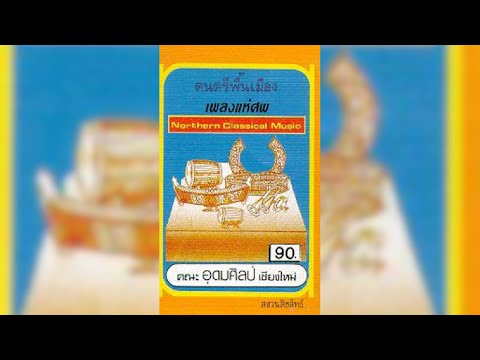
It is nearly impossible to find recordings of northern Thai funeral music outside northern Thailand. Even in Chiang Mai, cassettes are quite rare, despite the fact that these ensembles are essential for a proper ceremony. The ensemble and repertoire are both called “phleng hae sop”, or music for the corpse. A typical ensemble consists of ranat ek (wooden key xylophone), ranat lek (iron key xylophone), khong wong (gong circle), a pair of pii (double-reed winds, tuned a fifth apart) and several drums. Each piece marks a point in the funeral, ending with the cremation of the prasat (literally, castle), the pavilion that carries the body.
This recording was made by the most sought-after “phleng hae sop” group in Chiang Mai (circa 1990), led by master musician Udom Silapin na Chiang Mai (literally, Udom the Artist from Chiang Mai). The live recording was made by me at a temple in Chiang Mai. This was the moment when the procession left the temple for the cremation grounds.
As a frequent attendee of traditional Thai Buddhist funeral rite (which usually takes a week long, including Monk’s chanting evenings and cremation rites), it seems to me that there are very little (or almost none) variations (composition-wise, instrument-wise and especially song choices) between funeral music in each part of the country, at least in the era I’m currently living.
Anyway, the more interesting things are what the music conveys and what happens around it. Of course, ancient Thais may have their own unique perceptions of notes and timbres. I don’t think the concept of major and minor keys even exists in Thai musical notes system, but at least there are speeds. But to me there are just a couple of frequently-performed tunes that are slow-paced and actually mournful. Moreover, if you look at what happens during a week of the rite, it’s not hard to feel that the funeral rite isn’t necessary a pool of tears and is actually more positive than one may think, especially when a couple of days goes pass by.
On the bright side, the funeral rite is often one of rare occasions where family members gather together for the same causes, to celebrate the life of the loved one and send him/her to the better afterlife. Moreover, some of you may find that some Thai funeral tunes are more or less festive-sounding, and you’re not pretty far off. In the time of yore, especially in rural and suburban areas, when entertainment and communicational options were pretty scarce, and people tended to live far-away from each other (even in the same village, for some cases), funeral rite seemed to be of occasions for villagers or residents of a certain town to join and share a moment together.
People in the past, when they hear a really loud bang (usually generated by a certain type of fireworks) from the direction of the temple, they would know immediately that someone has passed away and the rite is destined to begin there, and it’s the time for them to gather there, no matter they know the deceased one personally or not. That’s exactly when the rite turns into something like a mini festival where different individuals/families associate and be nice to each other, and the accompanied music seems to naturally convey the vibe of the happening around it.
If you asked me, this is the reason I found funeral music featured here profoundly beautiful, apart from the ensemble’s tight performance. It reminds me about the time when a large chunk people come together, stop being selfish for a moment, celebrate the life of the deceased one and of each other and realize about everyone’s mortality.
Despite the title, funeral music is more like music about life than music about death. But, for a second thought, death is an inescapable part of everyone’s life isn’t it.