Published
Miserere
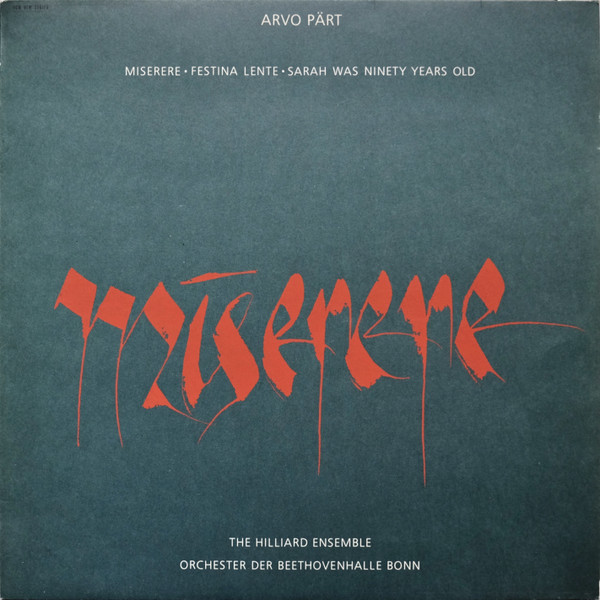
One of Arvo Pärt’s main compositions, Miserere (completed in 1989), is one of the most dramatic and contrasting pieces among his tintinnabuli works. The text of Dies irae depicts the Day of Judgement over all of mankind.
Arvo Pärt has described the creation of Miserere as follows: “This work is structured so that there is one breath for each word, as though after pronouncing each word one has to gather one’s strength for the next word. /…/ Imagine a criminal standing before the court, waiting for the final verdict, and he has one last chance to speak. There is not much time for these last explanations and he must choose his words with utmost care, because his fate depends on them. Each word is like a small weight trying to regain the balance of the scales.”
Characteristic of Pärt’s tintinnabuli works, here too the structure of the musical composition is based on text; entries from different voices are subordinated to very strict mathematical rules. Various parameters of the text (such as punctuation marks, number of syllables in words and emphases) all play an important role in the creation of the melody. Even pauses, which follow each word in the parts of the psalm text, and hence acquire special weight and significance, depend on punctuation marks, and their length is determined by a certain set of rules.
Miserere was dedicated to Paul Hillier and the Hilliard Ensemble.