Published
Dies irae
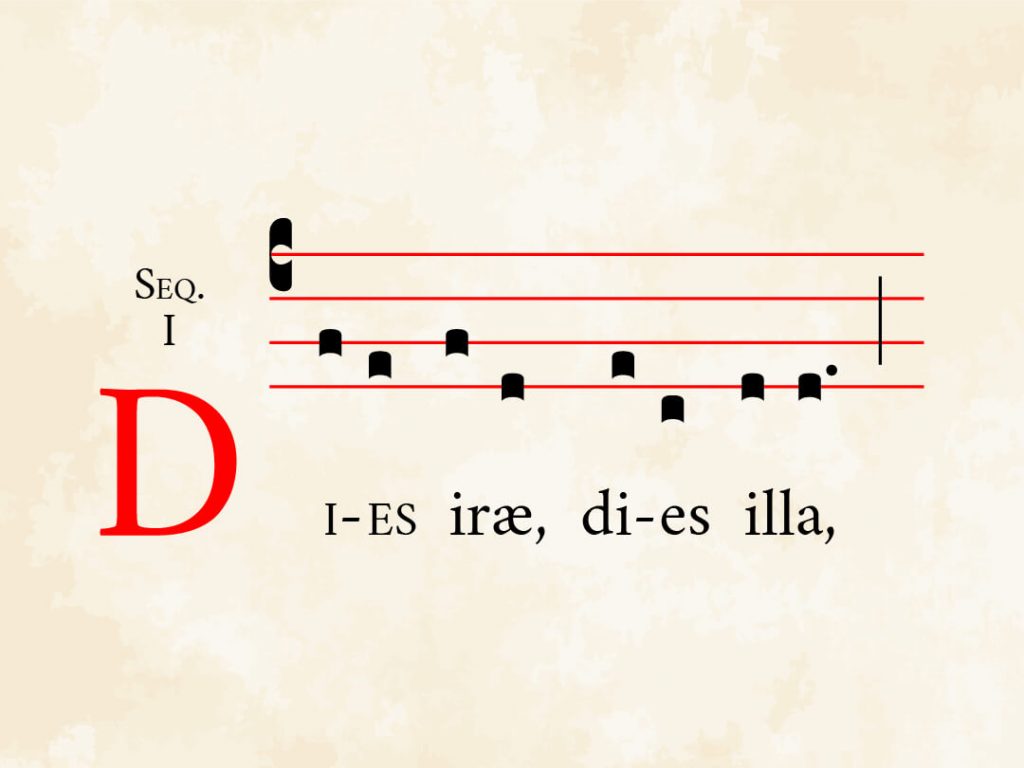
Dies irae (“Day of Wrath”) is a celebrated thirteenth-century Latin hymn attributed to the Franciscan Thomas of Celano (1200–1260), friend and biographer of Saint Francis of Assisi.
The poem describes the Day of Judgement, when the final trumpet summons the dead before the divine throne, where the elect will be saved and the condemned cast into eternal flames.
“Day of Wrath.” These words begin the medieval sequence that, after the Council of Trent (1545–63), became a fixed part of the Requiem Mass until its removal in 1970. The poem describes the Day of Judgement, when after death all people will be judged according to their actions. Over time, the sequence’s Gregorian melody became a rhetorical commonplace for representing in music the terrifying moment of the end of the world. This is the implicit connotation an informed listener would recognise upon hearing the motif in works as different as Joseph Haydn’s Symphony No. 103, Hector Berlioz’s Symphonie fantastique, Franz Liszt’s Totentanz and Gustav Mahler’s Symphony No. 2, Resurrection.