Published
Requiem / Laudes
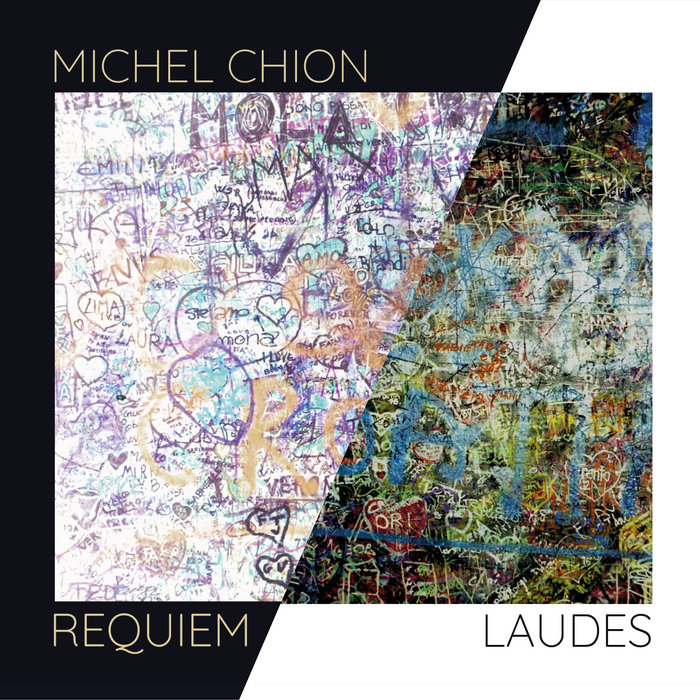
Voix enfermées, voix répandues
Among my favorite artists are the novelist Leo Tolstoy and the film director Federico Fellini. Their novels and films are often frescoes, with crowds and collective events, but each of their many characters has his or her own silhouette, his or her own life, his or her own individuality. Praise this variety.
The urge to praise, even in misfortune, seems to me to be one of the most bizarre and fascinating aspects of being human, but I can’t resist it. This is even why, without sharing Jacques Prévert’s opinions and atheism, I recognize him as an immense poet of celebration. For example, when he praises human life in an « Our Father » that has always impressed me: Our Father who art in Heaven, abide there, and we shall abide on earth… which in my mind is interwoven in an indistinguishable way with that of the Catholic canon. This braiding was one of the sources of inspiration for my « Requiem », my « Messe de terre » and « Laudes ».
The two pieces of almost equal length on this album, one completed in 1973 and the other in 2019, complement and respond to each other for me: it’s as if the ‘locked voices’ contained in the first work, and heard at the beginning of the second, eventually found their way out, and spread out into the world…
M.C., juillet 2023[English]
REQUIEM
Messe des funérailles
[1973] 37’37
In two parts and ten movements,
Commissioned by INA-G.R.M., produced in its studios; Grand Prix du Disque de l’Académie du Disque Français 1978; performers: André Allag (6), Michèle Bokanowski (2), Caroline Bruas (3, 7), Laure et Pierre Bruas (7), Robert Cahen (10), Michel Chion (1, 3, 4, 5, 7, 8, 9, 10), Catherine Colas (8), Jean-Pierre Colas (4, 7), Catherine Guérin (9), Bernard Guillochon (4), Geneviève Julien-Labruyère (1), vocal ensemble Le Madrigal de Paris, dir. Rachid Safir (1, 10); sound shooting, acoustic, instrumental (crumhorn, celesta, organ) and electronic sound creation, mixing, tape production: M.C.As with classical Requiems, the text of this « Requiem » is that of the Funeral Mass, to which are added an Épître (Epistle) (3), an Évangile (Gospel) (6) and the Our Father(8). It is presented in its original language (Latin or Greek), on rare occasions in French.
The « Requiem » was composed whilst thinking about the troubled minority of the living, rather than the silent majority of the dead. To the listener, it takes the form of an uneven dramatic course, the turnings and defections telling of a fundamental uncertainty in the face of life, death and faith.
At the level of form, the piece is based on a system of echoes and correspondence that is organized in a symmetrical fashion around an axis found in the middle of the work: movement 10 incorporates elements already heard in movement 1, movement 9 has elements from movement 2, etc., with variants and dissymmetries in the detail. The axis for this construction is to be found in the 6th movement, Évangile, where a symbolic rupture of the tape occurs, a breaking of the piece itself, that opens a gap of eternity in the flow of time, allowing a glimpse of « something else ».
With the « Requiem », my intention was not to deliver a message or a manifesto, whether pro- or anti-religious. Rather, the piece is a personal testimony, in which I invite the listener to project himself, if he should like to dwell in this music of his experience and sensibility.LAUDES 2015-19, 36’17
premiered at Festival Futura 2019 by Jonathan Prager, on Motus Acousmonium; sound recording, instrumental creation (prepared piano and clavichord), vocal and sound creation, production, mixing: M.C.
Produced in Berlin and Paris, using the composer’s own equipment.« Lauds » (from the Latin Laudare, to praise) is a Christian service to celebrate the Creator at the dawn of each new day, often using texts from the Bible, including Psalm 150, set to music by Stravinsky, among others. It is the latter text, in Latin and German, spoken by computer-generated voices, that can be heard in the first moment of my work. This moment, Les voix enfermées (The locked voices), which lasts around 14 minutes, was premiered on 9 June 2015 at the Wissenschaftskolleg in Berlin under the title Finsternis und Lobgesang (Darkness and song of praise), during my year-long stay as a fellow.
Since then, using the same personal techniques, I have composed two new moments in Paris, one of which, Appels (2’30), is simply an interval of time in which the fixed silences that precede and follow it are of unusual length.
With En chemin (On the road), a long sideways tracking shot lasting around twenty minutes and set outdoors, in which we end up joining a character maniacally repeating Laudate (Praise), crossing places, meeting crowds and crossing paths with other characters (including a woman who seems mad), I wanted to suggest a journey in the open air on a road that is if not infinite, at least has no known end. The work ends with the words, taken from Psalm 43: I will go to the altar of God.
The three moments of «Lauds» are no longer separable and must be played in their entirety, including the silences, at each public performance, which is why they appear here on a single track.