Published
Quatuor pour la fin du temps
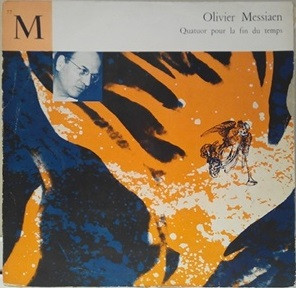
Quatuor pour la fin du Temps (French pronunciation: [kwatɥɔʁ puʁ la fɛ̃ dy tɑ̃]), originally Quatuor de la fin du Temps (“Quartet of the End of Time”), also known by its English title Quartet for the End of Time, is an eight-movement piece of chamber music by the French composer Olivier Messiaen.
Messiaen wrote the piece while a prisoner of war in German captivity and it was first performed by his fellow prisoners. It is generally considered one of his most important works.
Messiaen was 31 years old when France entered World War II. He was drafted into the French army as a medical auxiliary. In June 1940, he was captured by the German army and imprisoned in Stalag VIII-A, a prisoner-of-war camp in Görlitz, Germany (now Zgorzelec, Poland). While in transit to the camp, Messiaen showed the clarinetist Henri Akoka, also a prisoner, the sketches for what would become Abîme des oiseaux. Two other professional musicians, violinist Jean le Boulaire and cellist Étienne Pasquier, were among his fellow prisoners, and after he managed to obtain some paper and a small pencil from a sympathetic guard (Carl-Albert Brüll, 1902–1989), Messiaen wrote a short trio for them; this piece later became the quartet’s Intermède. Later, he decided to write for the same trio with himself at the piano, developing it into its current state. The combination of instruments was unusual at the time, but not without precedent: Walter Rabl had composed for it in 1896, as had Paul Hindemith in 1938.
The quartet was premiered at the camp on 15 January 1941 in front of about 400 prisoners and guards. Messiaen claimed that 5,000 people attended the performance and that the musicians had decrepit instruments, but those claims are now considered “somewhat exaggerated”: 62–65 The cello was bought with donations from camp members: 34 Messiaen later recalled, “Never was I listened to with such rapt attention and comprehension.”
Several months later, Messiaen was released.
Messiaen and Etienne Pasquier (cellist at the initial premiere) later recorded the quartet on LP for Club Français du Disc (1956), together with Jean Pasquier (violin) and André Vacellier (clarinet).
Messiaen wrote in the Preface to the score that the work was inspired by text from the Book of Revelation (Rev 10:1–2, 5–7, King James Version):
And I saw another mighty angel come down from heaven, clothed with a cloud: and a rainbow was upon his head, and his face was as it were the sun, and his feet as pillars of fire… and he set his right foot upon the sea, and his left foot on the earth.… And the angel which I saw stand upon the sea and upon the earth lifted up his hand to heaven, and sware by him that liveth for ever and ever… that there should be time no longer: But in the days of the voice of the seventh angel, when he shall begin to sound, the mystery of God should be finished…