Published
Cantus in Memoriam Benjamin Britten
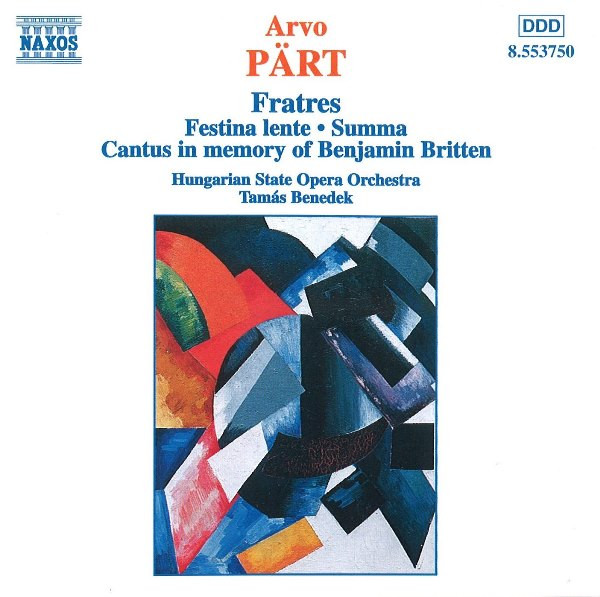
The work is an early example of Pärt’s tintinnabuli style, which he based on his reactions to early chant music. Its appeal is often ascribed to its relative simplicity; a single melodic motif dominates and it both begins and ends with scored silence.
The cantus was composed as an elegy to mourn the December 1976 death of the English composer Benjamin Britten. Pärt greatly admired Britten. Pärt described Britten as possessing the “unusual purity” that he himself sought as a composer.
Pärt has said of “tintinnabulation”: “The complex and many-faceted only confuses me, and I must search for unity. What is it, this one thing, and how do I find my way to it? Traces of this perfect thing appear in many guises – and everything that is unimportant falls away. Tintinnabulation is like this. Here I am alone with silence. I have discovered that it is enough when a single note is beautifully played. This one note, or a silent beat, or a moment of silence, comforts me.”
Each part except the viola is split into two, with one playing notes from the A minor scale, and the other playing only notes from an A minor chord (i.e., A–C–E). These choices have a definite symbolism for Pärt. The former “always signifies the subjective world, the daily egoistic life of sin and suffering, [the latter] meanwhile, is the objective realm of forgiveness.” For Pärt, there is only an apparent dualism here; he believes that “all is one.”
After the three beats of silence that open the score, a tubular bell is struck three times very quietly (pianissimo), with 12 beats between the strikes and gap of 18 beats between the groups of three. This bell tells of the death of Britten—it is the funeral bell.
The piece is a meditation on death. Pärt’s biographer, Paul Hillier, suggests that “how we live depends on our relationship with death: how we make music depends on our relationship to silence.” It is significant that the piece begins and ends with silence—that the silence is written in the score. This silence creates a frame around the piece and has spiritual significance. It suggests that we come from silence, and return to silence; it reminds us that before we were born and after we die we are silent with respect to this world.
Speaking on his reaction to Britten’s death, Pärt admitted,
Why did the date of Benjamin Britten’s death – 4 December 1976 – touch such a chord in me? During this time I was obviously at the point where I could recognise the magnitude of such a loss. Inexplicable feelings of guilt, more than that even, arose in me. I had just discovered Britten for myself. Just before his death I began to appreciate the unusual purity of his music – I had had the impression of the same kind of purity in the ballads of Guillaume de Machaut. And besides, for a long time I had wanted to meet Britten personally – and now it would not come to that.
“Tintinnabulation is an area I sometimes wander into when I am searching for answers – in my life, my music, my work. In my dark hours, I have the certain feeling that everything outside this one thing has no meaning. The complex and many-faceted only confuses me, and I must search for unity. What is it, this one thing, and how do I find my way to it? Traces of this perfect thing appear in many guises – and everything that is unimportant falls away. Tintinnabulation is like this. . . . The three notes of a triad are like bells. And that is why I call it tintinnabulation.
The music of Cantus is born from silence. The score begins with a three-bar pause followed by bell tolls that remind us of a funeral bell at a cemetery. One by one, five layers of voices enter in a descending tone row in a minor key, like five strands which intertwine to form the pattern of a sound fabric. There is something mysterious in this flow of music because the listener does not perceive the tone rows descending at different speeds as a disturbing dissonant cluster. Rather, the dissonances delicately slip by, without straining the ear or feeling heavy. The endlessly flowing sound river of the string orchestra is reminiscent of the hollow sound of church bells – a cluster of sounds in which a certain order and symmetry can be perceived.
And then suddenly the music stops – or almost. In this moment there is a sense of spiritual death. /…/ We die to our old self, our old self-centredness. But with spiritual death there is spiritual renewal, and even though we don’t hear the striking of the bell, it is struck, and rings on after the reverberations of the strings have died away. /…/ And so we return to silence, once again written into the score. But this is not the silence of the absence of sound. It is the silence that is sound, and the sound is silence.” (Dharmachari Jayarava “Cantus in Memory of Benjamin Britten by Arvo Pärt”, Jayarava.org, 2006)