Published
Passio
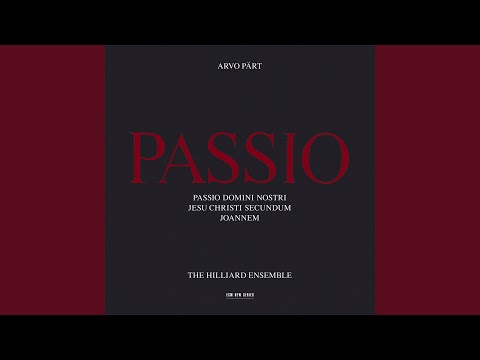
Passio Domini Nostri Jesu Christi secundum Joannem (The Passion of Our Lord Jesus Christ According to John), also known as the St. John Passion or simply Passio, is a passion setting by Arvo Pärt. When Pärt left Estonia for Austria in 1980, he took with him the first sketches for the St. John Passion, which would become the culmination of the tintinnabuli style.
In composing the work, text setting and declamation were foremost in Pärt’s mind: all of the musical elements in the piece, from rhythm to pitch, are in some way determined by the text.
American composer Eric Whitacre used the two initial chords of the conclusion (Qui passus es) in his motet Lux Aurumque, applying them to the words natum (new-born) and thus linking birth and death of Christ to reincarnation.
Passio has a very important place in our musical heritage as the Hilliard Ensemble. It was really the defining moment that introduced us fully to Arvo Pärt’s music. And it was performing Passio, coming to know and understand Passio, that sort of sealed our relationship – the realisation that this is really something unique. If you look at the score of Passio and analyse it, it is very, very spartan, very sparse in the sense that there are actually only three keys used. And then at the very end, just for the very end, at the critical moment when Christ is on the cross and is about to die, suddenly, the four Evangelists come together on one unison A-note. And then there’s this silence, this death – he gave up the ghost, we’d say, his spirit isn’t in him, he gave up his spirit. And then there’s this extraordinary moment when the choir and everybody comes in, in D-major. So this chord comes in and it just goes right through your body! It’s an amazing moment – every time, it sends shivers down my spine. It’s like the richest Brahms you’ve ever heard, and you realise that there is life afterwards. This is the most important moment, the death, but it’s actually looking forward, it’s for a reason, it’s a positive thing, and I think that this last page is the most stunning page of music you could ever wish to hear.