Published
Nam June’s Spirit Was Speaking To Me
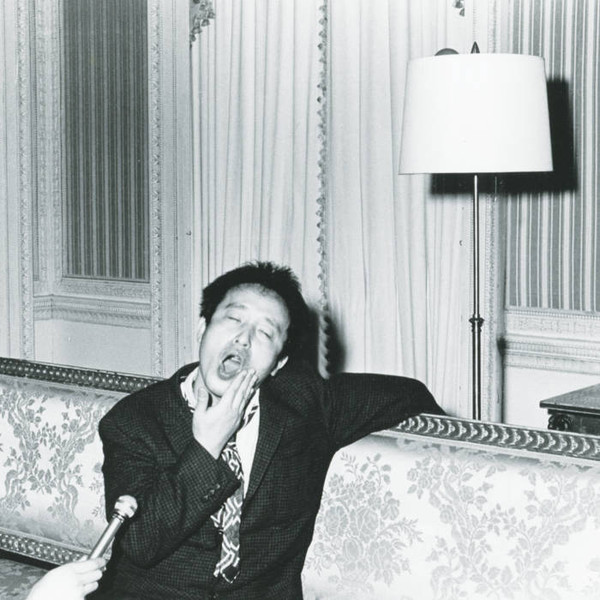
A spellbinding tribute from one multi-faceted artist to another. New York-based artist Aki Onda (b. 1967) conjured a transduction to the Korean multi-media pioneer Nam June Paik (1932-2006). Aki himself describes the project:
“Nam June’s Spirit Was Speaking to Me occurred purely by chance. In 2010, I was spending four days at Nam June Paik Art Center in South Korea for a series of performances and had plenty of free time to wander. The building was packed with Paik’s artwork and related material. I have always felt a close kinship with him as an artist, and so it was a great opportunity to immerse myself in his works and ephemera.
It was that night I made the first contact, via a hand-held radio in a hotel room in Seoul. It was literally out of the blue. Scanning through the stations, I stumbled upon what sounded like a submerged voice and I began to record it in fascination. I concluded this was Paik’s spirit reaching out to me.
The project continued to grow organically as I kept channeling Paik’s spirit over long distance and receiving cryptic broadcasts/messages. The series of séances, conducted in different cities across the globe, began in Seoul in 2010, and continued in Köln, Germany in 2012, Wrocław, Poland in 2013, and Lewisburg, USA in 2014. The original recordings were captured by the same radio which has a tape recorder, with almost no editing, save for some minimal slicing and mastering.
Paik is known for his association with shamanism, a practice that constantly surfaces in his works all through his career. In an interview, he stated “In Korea, diverse forms of shamanism are strongly remained. Even though I have created my work unconsciously, the most inspiring thing in my work came from Korean female shaman Mudang.” Paik himself was a master shaman and vividly used shaman rituals and symbols for staging his performances and installations.
These recordings also became a way for me to explore the mythic form of radio—a medium which is full of mysteries. The transmissions captured may be “secret broadcasts” on anonymous radio stations. There are in fact hundreds of those stations around the world, although the numbers dwindle as clandestine messages can now be sent via encrypted digital channels. Some of these stations were likely for military use or espionage or relics of the Cold War. But many others continue without apparent explanation. These are just some of the questions that remain unanswered.”Commissioned in 2017 by documenta 14’s radio program “Every Time A Ear di Soun,” these recordings were continually broadcast on eight radios stations around the world that year. Nam June’s Spirit is a beautifully formed homage, I cannot think of any other like it. An intimate, flickering language discovered through the air. The LP comes replete with a booklet of rare photographs of Paik. These images were shot on the set of Michael Snow’s film Rameau’s Nephew… (1974), although the scene was not included in the final cut.
-Sean McCann, 2020
I have had a habit of collecting found and discarded objects over the years. Though it was a slow process, they started to form some natural groupings. It’s an extension of my cassette practice to expand the realm of reminiscence beyond my territory and consciousness — a sort of collective consciousness in order to reach out to something universal. Yeah, those are “dead” as they are no longer in use. But “death” is an ambiguous notion that allows us various interpretations. If we die, that terminates all biological functions which sustain a living organism, and the body will be gone. In the case of the materials, the form itself remains, but something will be lost. In both cases, I believe spirits remain, or memories or the stream of consciousness is preserved afterlife, though those are invisible.
As you know, I developed my career as a musician first, and those experiences helped me to shape the foundation as a performer. I was playing my cassette field recording, which I consider sounds of past memories, and a sense of communication with the dead was a perfect match. I hypnotized myself before the show, empty my mind, and stopped the stream of consciousness. Through strong meditation and concentration, I get into a strong trance state. And, if the audience joins in, it works as a communal experience. I had made my own “ritual” and I started bringing many found objects on stage as ornaments, the same as the setting for the candomblé or macumba. It’s like a spectacle-slash-performance and not really a music concert as the visual presentation is as equally important as the aural presentation. I wanted to create an animistic sort of space — everything has aesthetic and cultural value.
“It was really out of the blue, but somehow I felt the sensation that Nam June Paik was speaking to me,” Onda said. “It’s hard to explain, just intuition, so I made a recording. I always carry a cassette Walkman that has a radio.”