Published
Make Visible The Ghosts
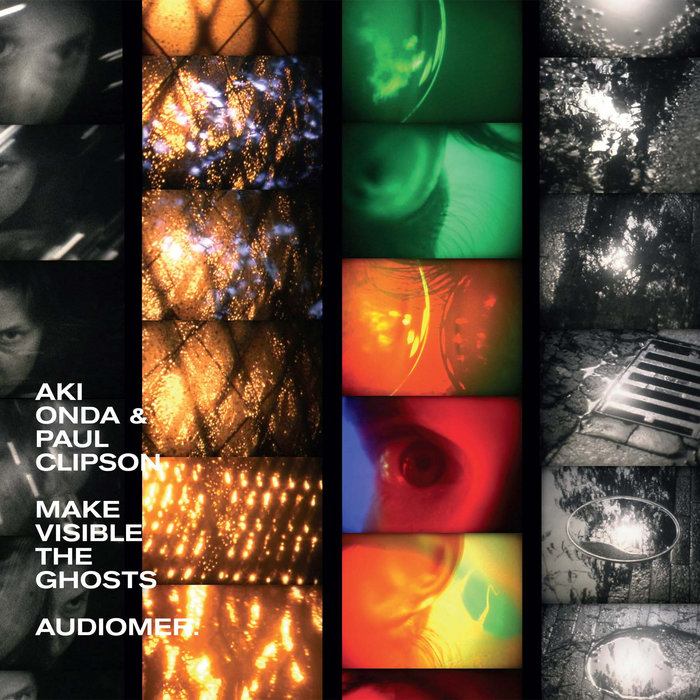
On Make Visible the Ghosts, New York-based musician Aki Onda composed the soundtrack for the images of the San Francisco experimental filmmaker Paul Clipson, who suddenly passed away on February 3, 2018.
Onda and Clipson completed their collaboration work Make Visible The Ghosts—a combination of vinyl LP of Onda’s music and large-size collage artwork by Clipson—a few months before Clipson’s departure from life. The work is composed of the materials they used for their performance in New York in 2012 and developed over the three years from 2015 to 2017.
Onda notes: “The loss of Paul has left a huge hole in our mind including his friends and collaborators. Paul is no longer here, and this is a chance to remember him and his images that extended and expanded our perception of how the world can be seen and heard.”
I have had a habit of collecting found and discarded objects over the years. Though it was a slow process, they started to form some natural groupings. It’s an extension of my cassette practice to expand the realm of reminiscence beyond my territory and consciousness — a sort of collective consciousness in order to reach out to something universal. Yeah, those are “dead” as they are no longer in use. But “death” is an ambiguous notion that allows us various interpretations. If we die, that terminates all biological functions which sustain a living organism, and the body will be gone. In the case of the materials, the form itself remains, but something will be lost. In both cases, I believe spirits remain, or memories or the stream of consciousness is preserved afterlife, though those are invisible.
As you know, I developed my career as a musician first, and those experiences helped me to shape the foundation as a performer. I was playing my cassette field recording, which I consider sounds of past memories, and a sense of communication with the dead was a perfect match. I hypnotized myself before the show, empty my mind, and stopped the stream of consciousness. Through strong meditation and concentration, I get into a strong trance state. And, if the audience joins in, it works as a communal experience. I had made my own “ritual” and I started bringing many found objects on stage as ornaments, the same as the setting for the candomblé or macumba. It’s like a spectacle-slash-performance and not really a music concert as the visual presentation is as equally important as the aural presentation. I wanted to create an animistic sort of space — everything has aesthetic and cultural value.