Published
Field Recording # 7
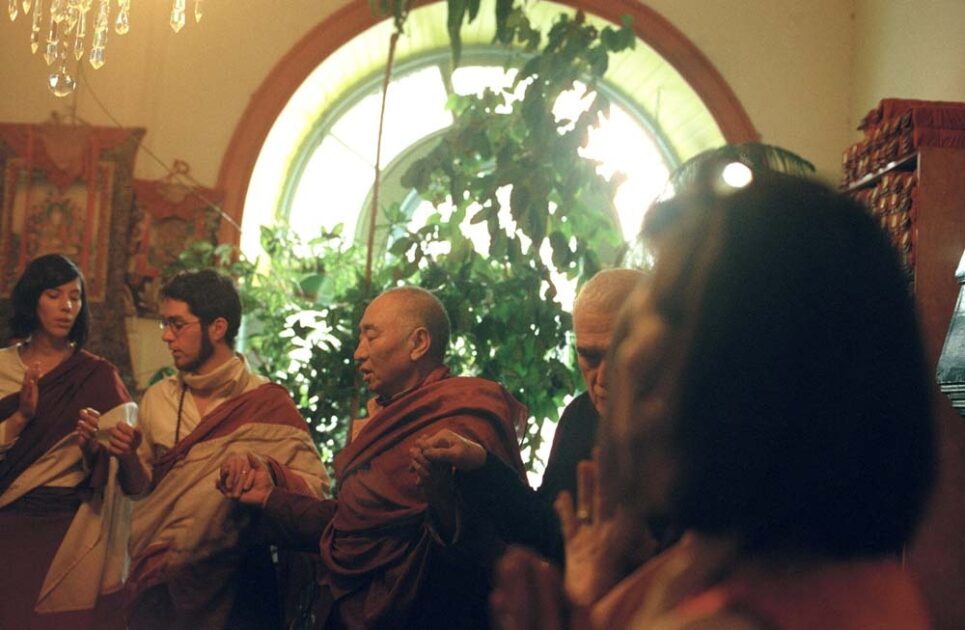
The living room was emptied for the event but still decorated with many tall plants, colorful Buddhist paintings, et cetera around the walls. Marcus told us that the room once housed the back catalog of reel-to-reel tapes of Giorno Poetry Systems, a multimedia venture label founded in the ‘60s that explored “what-poetry-can-be.” After the ceremony, Giorno showed us his studio and another room, where William S. Burroughs once lived. Some of his belongings were still there, and I found a typewriter with Burroughs’s name printed on it, though Giorno claimed it’s his and “Burroughs” is just the name of the brand. Ghosts hover anyway, as this building—first built as a YMCA in the late 19th century— has kept the history of the New York underground illuminated (Robert Rauschenberg, Jasper Johns… and many artists hung out with Giorno there). More dimly, one could feel the lurid history of the Bowery in its midst. The Bowery: one of the worst neighborhoods in Manhattan at the time. Until relatively recently, it was a dark place where the criminals, alcoholics, drug addicts, prostitutes, and adventurous bohemians resided. You can smell or sense it, although once you step out of the building this aura dissipates and you’re back in the gentrified panorama of museums, galleries, shiny boutiques, and fancy restaurants. Smells like money instead.
Recalling that experience triggered another memory in my mind…
In these empty houses, we often did a ritual to burn things we stole. We would stare at the burning of the goods until they were nothing but ashes. There was an anarchic mood in the Buraku, since the kids all hid a feeling of “we are not part of this society” deep in their mind. One day, we set fire to an empty house and it burned down. My memory is vague and I don’t remember what happened afterward…
Each installment of this ongoing portfolio series features an original audio recording by a musician, composer, or sound artist along with their commentary. Projects range from raw documentation of live performances to sound collage and experiments with aleatory music.
I have had a habit of collecting found and discarded objects over the years. Though it was a slow process, they started to form some natural groupings. It’s an extension of my cassette practice to expand the realm of reminiscence beyond my territory and consciousness — a sort of collective consciousness in order to reach out to something universal. Yeah, those are “dead” as they are no longer in use. But “death” is an ambiguous notion that allows us various interpretations. If we die, that terminates all biological functions which sustain a living organism, and the body will be gone. In the case of the materials, the form itself remains, but something will be lost. In both cases, I believe spirits remain, or memories or the stream of consciousness is preserved afterlife, though those are invisible.
As you know, I developed my career as a musician first, and those experiences helped me to shape the foundation as a performer. I was playing my cassette field recording, which I consider sounds of past memories, and a sense of communication with the dead was a perfect match. I hypnotized myself before the show, empty my mind, and stopped the stream of consciousness. Through strong meditation and concentration, I get into a strong trance state. And, if the audience joins in, it works as a communal experience. I had made my own “ritual” and I started bringing many found objects on stage as ornaments, the same as the setting for the candomblé or macumba. It’s like a spectacle-slash-performance and not really a music concert as the visual presentation is as equally important as the aural presentation. I wanted to create an animistic sort of space — everything has aesthetic and cultural value.