Published
Homenaje a Haydn
Tombeau. In memoriam
The tombeau (“tomb” in French) is a composition written in memory of someone, usually a composer, whose origins lie in Baroque France. It is therefore an elegiac work that mourns a person’s death while paying tribute to them. The genre’s close connection with French musical culture helps explain its revival at the beginning of the twentieth century, when a group of French composers looked to the past for a distinctive musical identity in response to the prevailing Austro-German hegemony.
One of the most direct ways to honour an admired dead composer was to include a musical quotation from their work, as Manuel de Falla did in his Homenaje. Originally written for guitar and later adapted for piano, it formed part of the collective work Pour le tombeau de Debussy (1920). Falla introduces a theme conceived by Debussy for La soirée dans Grenade, with its unmistakable Andalusian resonances. In 1935, Falla composed another work in a similar spirit, Pour le tombeau de Paul Dukas, in memory of one of the French composers most influential upon the generation of Spaniards living in Paris. Among them was the young Joaquín Rodrigo, who also dedicated a sonata to Dukas that same year, commissioned by La Revue musicale.
Many works have been conceived as tributes or in memoriam pieces for a loved one—contemporary or historical, real or imagined—without explicitly using the title tombeau. In Ravel’s Pavane pour une infante défunte (1899), the composer evokes a gently imagined death in a melancholy tone. In Homenaje a Haydn (1909), Debussy begins from a theme based on the notes encoded in the Viennese composer’s name, marking the centenary of Haydn’s death.
Hommage à Joseph Haydn was commissioned by Jules Écorcheville for the journal of the International Music Society and its special issue devoted to Haydn on the centenary of the Austrian composer’s death. Alongside Debussy, the contributors were Maurice Ravel, Paul Dukas, Reynaldo Hahn, Vincent d’Indy and Charles-Marie Widor.
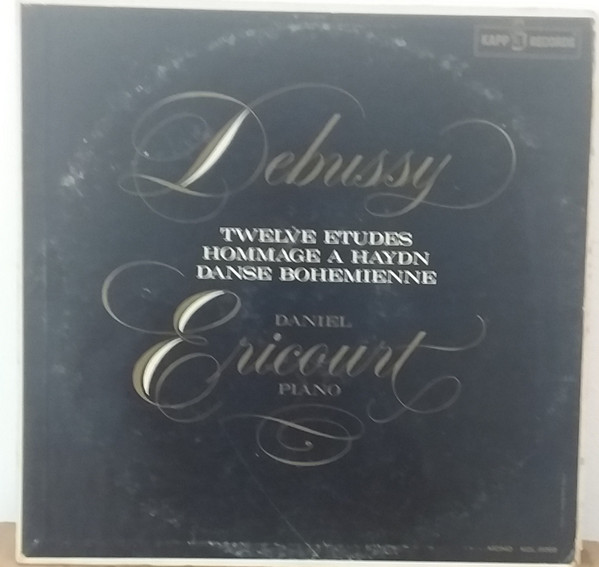
Hommage à Haydn is a piano work by Claude Debussy, composed as part of the collective tribute Hommage à Joseph Haydn initiated by the French musicologist and writer Jules Écorcheville to mark the centenary of Joseph Haydn’s death in 1909.
Debussy composed the score in May 1909. It was published under the title Sur le nom d’Haydn (“On the name of Haydn”) in January 1910 and then by Durand later that year as Hommage à Haydn.
As in the B-A-C-H motif, the compositional process assigns musical notes to letters of the alphabet, creating a musical cryptogram. The system used here is German; different systems assign different notes to individual letters. Thus B natural is represented not by “B,” as in English notation, but by “H,” as in German. The work is built around an imposed motif derived by translating the name HAYDN into notes: H–A–Y–D–N, or B–A–D–D–G.